

Have you ever wondered how the changes introduced within your organization affect individual departments and people in your company? There is a tool that can help identify these impacts and assist in managing changes. This tool is called the profit and work matrix.
In this article, I will try to explain what it is, its applications, and how it can be used in practice.
What is the Profit and Work Matrix?
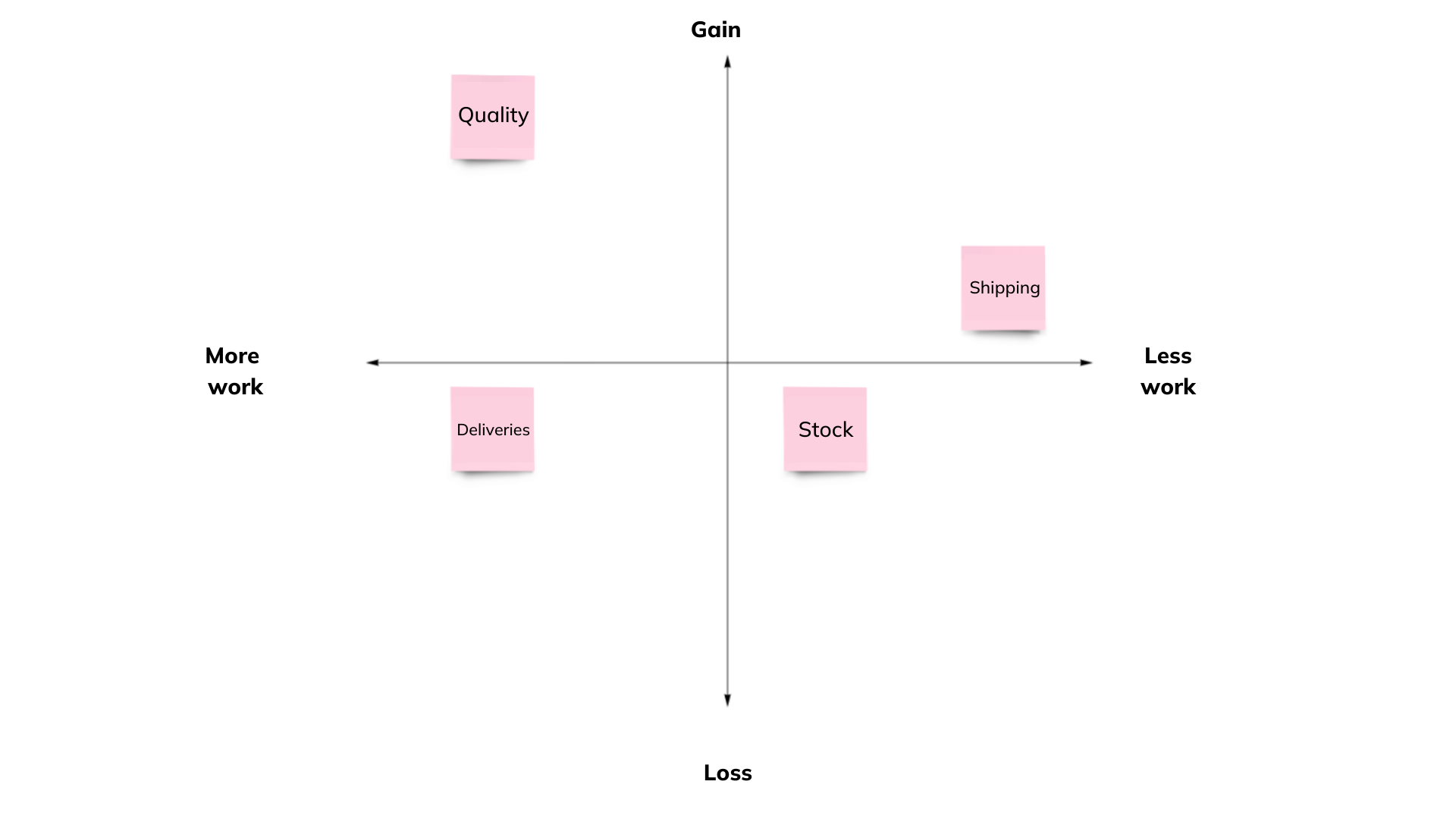
The profit and work matrix is a tool that focuses on understanding the impact of organizational changes on individual groups within the company. It is a kind of map that allows you to trace which departments, roles, or people will have more or less work, as well as what benefits or losses will result from the change. This method of analysis enables a better understanding of the reactions of individual teams to changes and helps in making informed and optimal decisions.
The model can be illustrated as follows:
Why Does the Matrix Work?
The use of our scheme can be practically simplified to three basic assumptions:
- Sometimes, to achieve more, we can simply put in more work.
- Conversely, to achieve the same final effect, we can reduce the amount of work but limit some employees' capabilities.
- No one wants to be at the bottom left - having more on their plate instead of reaping benefits incurs losses.
The Profit and Work Matrix in Practice
These principles end the theory. To better understand how it translates into professional everyday life, let’s look at a practical example. The organization I worked with operates in the field of food product quality management. The system we implemented was designed to combine the work of several departments, making it an ideal case to demonstrate the applications of this tool.
Case Study
Area: Food Product Quality Management
Departments and Responsibilities:
- Deliveries – what goods have been purchased and are being delivered.
- Warehouse – what products have arrived at individual warehouses.
- Quality – whether the goods meet the established criteria.
- Shipping – what we are sending to the stores.
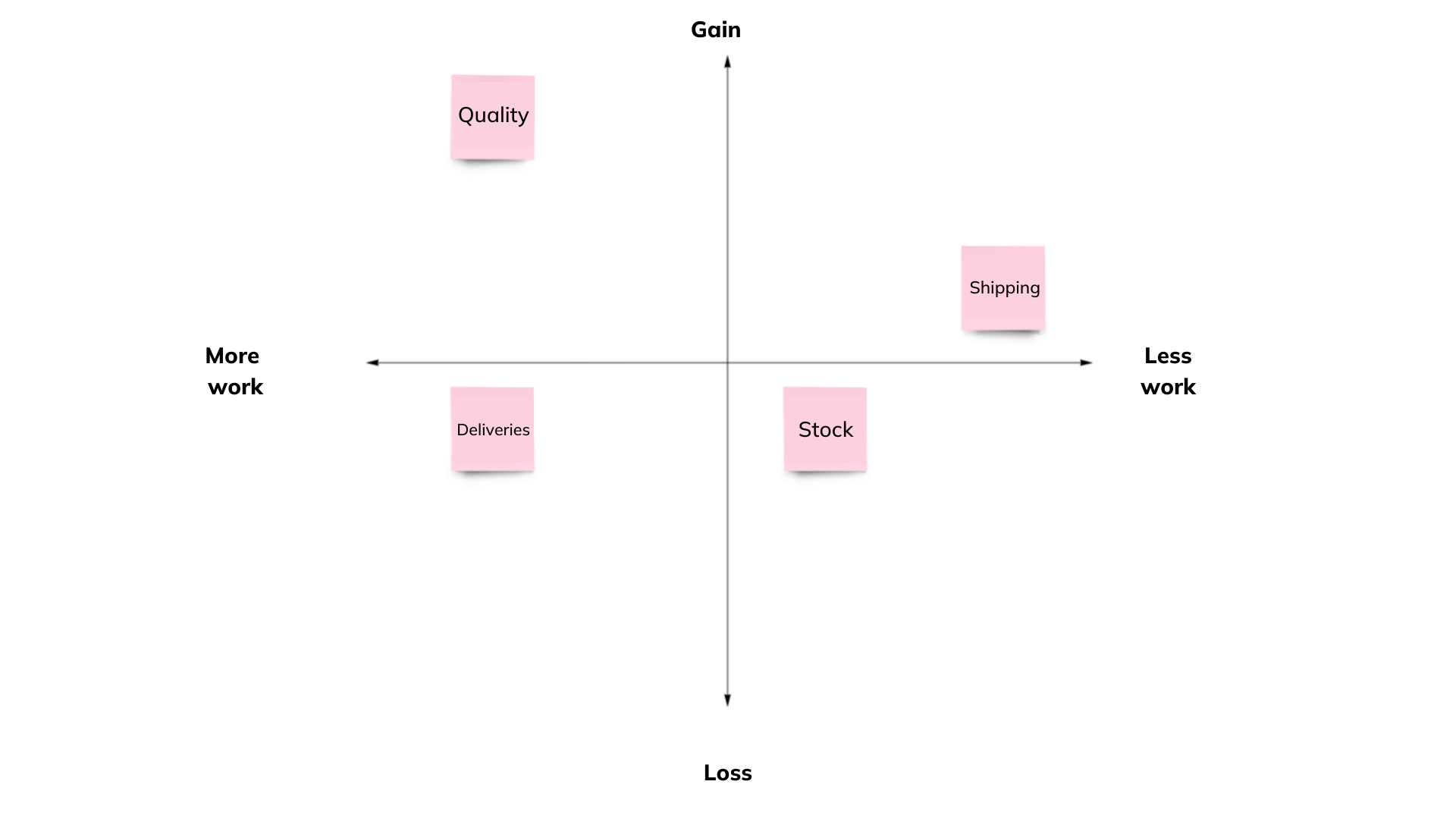
The matrix looks as follows:
What Can We Read from the Matrix?
One of the biggest advantages of mapping the entire distribution of profits and work is its visual simplicity. The chart format allows you to quickly see what works well and what does not. It also helps identify areas that need improvement as soon as possible.
Can you spot the following conclusions by analyzing our example matrix?
- The Warehouse and Shipping had less work because some data was already available in the system.
- The Warehouse was somewhat limited in manipulating deadlines, which resulted in some team work losses.
- The Quality Department had much more work, but thanks to the structured form, they could perform higher-level analyses and more effectively detect errors.
- The Deliveries Department also had much more work. They were at the beginning, so they bore the entire burden of entering product data into the system. Simultaneously, they did not achieve any gain. They were not interested in data in the system - they wanted to transfer the responsibility as quickly as possible.
Which department do you think was rebelling?
It’s not hard to guess that Deliveries had the most reasons to be dissatisfied.
Fixing Defects with the Profit and Work Matrix
By analyzing the profit and work matrix, we can predict the behavior of individual departments and teams. If we notice that a department has to work more and loses flexibility, it is highly likely that dissatisfaction and resistance will arise. However, there are many ways to detect and fix defects.
In the case of the Deliveries Department from the example, we can consider adding a function that makes employees feel they are gaining benefits. Is there a way to reduce the amount of work or simplify processes? Sometimes even small changes can make a huge difference, changing the position on the matrix as follows:
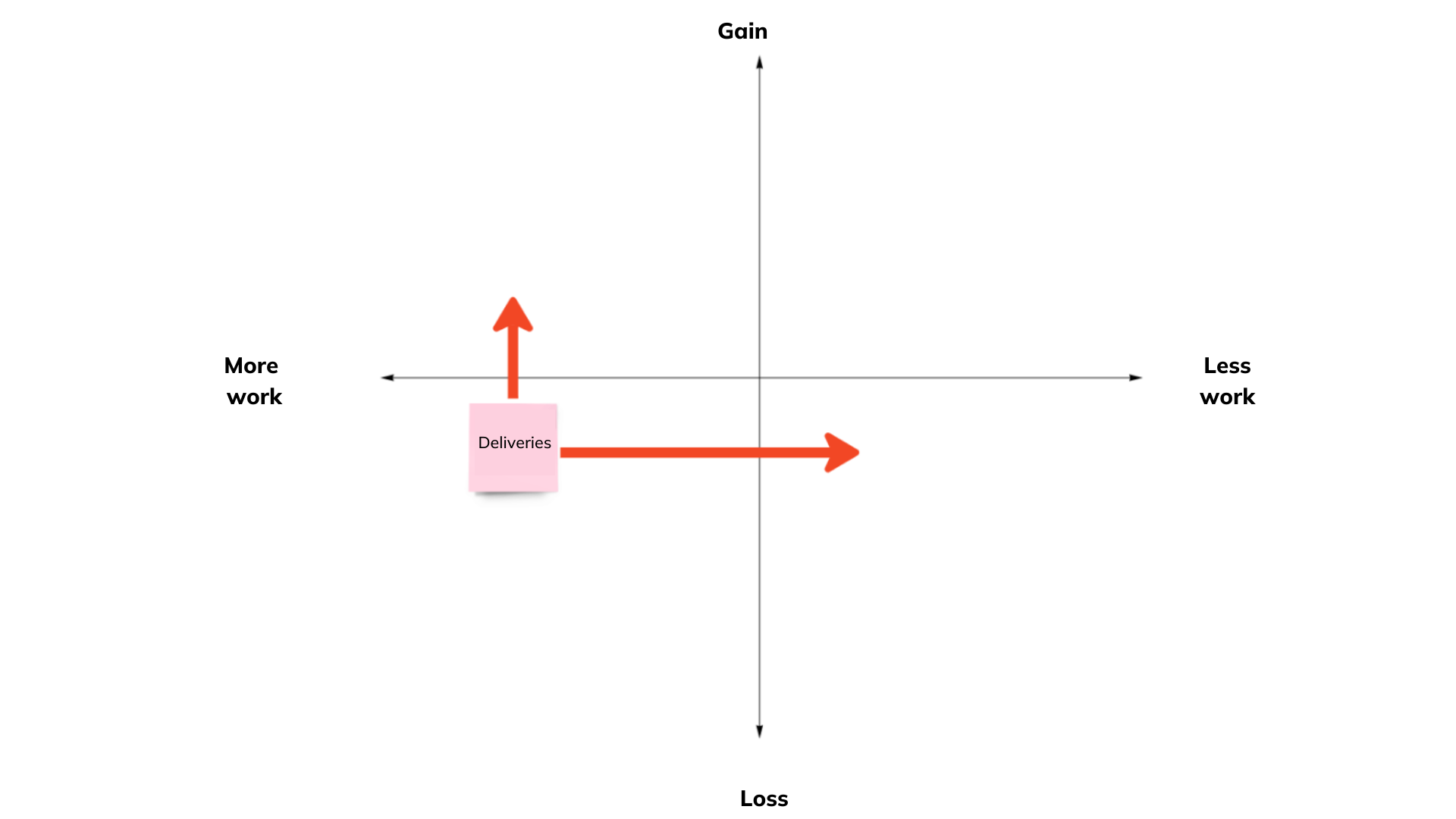
In our example, we used the second solution. We added a data importer from Excel to the system, which significantly reduced the work of the Deliveries Department. Employees could now run the importer once a week and forget about the task, significantly reducing their workload.
Summary
The profit and work matrix is a powerful tool that helps understand the impact of organizational changes on individual departments and people in the company. Its analysis allows for predicting teams' reactions to changes, which is crucial for effective process management within the company. It is worth spending time mapping profits and losses and looking for ways to ensure changes bring benefits to all involved parties.
Remember, the profit and work matrix is just one of the tools that can be used in change management. There are many other techniques and strategies that can help carry out effective and harmonious organizational changes. If you are interested in the topic, I encourage you to further explore the subject, for example, by reading my other articles.
How do you think the profit and work matrix can be applied to support the change process in your company? Share your experiences in the comments!